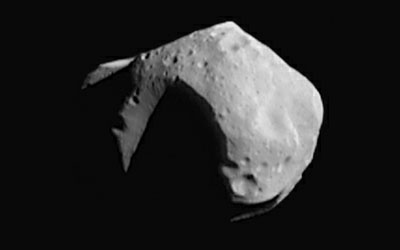
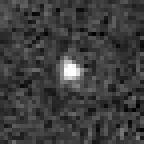
10370 Hylonome (; provisional designation 1995 DW2) is a minor planet orbiting in the outer Solar System. The dark and icy body belongs to the class of centaurs and measures approximately 72 kilometers (45 miles) in diameter. It was discovered on 27 February 1995, by English astronomer David C. Jewitt and Vietnamese American astronomer Jane Luu at the U.S. Mauna Kea Observatory in Hawaii, and later named after the mythological creature Hylonome.
Classification and orbit
Centaurs are a large population of icy bodies in transition between trans-Neptunian objects (TNOs) and Jupiter-family comets (JFCs), their orbits being unstable due to perturbations by the giant planets. Currently, Uranus controls Hylonome's perihelion and Neptune its aphelion.
Hylonome is a carbonaceous C-type body that orbits the Sun in the outer main-belt at a distance of 18.9–31.4 astronomical units (AU) once every 126 years and 2 months (46,073 days). Its orbit has an eccentricity of 0.25 and an inclination of 4° with respect to the ecliptic. It is a Neptune-crosser, and an outer-grazer of the orbit of Uranus, which it hence does not cross. Its minimum orbital intersection distance with Neptune and Uranus is 0.35854 and 0.52875 AU, respectively.
It is estimated to have a relatively long orbital half-life of about 6.37 million years. In the year 3478, it will pass within approximately 85 gigameters or 0.5682 AU of Uranus, and its semi-major axis will be reduced from 25.1 to 23.5 AU.
Naming
This minor planet was named for Hylonome, a female centaur in Greek mythology. In the epic tragedy, she lost her husband, the handsome centaur Cyllarus, who was accidentally killed by a spear. Heartbroken, she then took her own life by throwing herself on the spear. The official naming citation was published on 26 July 2000 (M.P.C. 41030).
A symbol derived from that for 2060 Chiron, , was devised in the late 1990s by German astrologer Robert von Heeren. It replaces Chiron's K with a Greek capital upsilon (Υ) for Hylonome (Ὑλονόμη).
Physical characteristics
Observations with the infrared Spitzer Space Telescope indicate a diameter of 70±20 kilometers, whereas the Collaborative Asteroid Lightcurve Link assumes a standard albedo for carbonaceous bodies of 0.057, giving it a diameter of 75.1 kilometers with an absolute magnitude of 9.35.
A study in 2014, using data from Spitzer's Multiband Imaging Photometer (MIPS) and Herschel's Photodetector Array Camera and Spectrometer, gave a low albedo 0.051±0.030 and a diameter of 74±16 kilometers, based on an absolute magnitude of 9.51±0.08. The study concluded that among the observed population of centaurs, there is no correlation between their sizes, albedos, and orbital parameters. However, the smaller the centaur, the more reddish it is.
See also
- List of centaurs (small Solar System bodies) § 10370
References
External links
- 10370 Hylonome as seen around 08 Sept 2009 by the new Hubble WFC3.
- List Of Centaurs and Scattered-Disk Objects, Minor Planet Center
- Discovery Circumstances: Numbered Minor Planets (10001)-(15000) – Minor Planet Center
- AstDyS – (10370) Hylonome Ephemerides
- Asteroid Lightcurve Database (LCDB), query form (info Archived 16 December 2017 at the Wayback Machine)
- Dictionary of Minor Planet Names, Google books
- Asteroids and comets rotation curves, CdR – Geneva Observatory, Raoul Behrend
- 10370 Hylonome at AstDyS-2, Asteroids—Dynamic Site
- Ephemeris · Observation prediction · Orbital info · Proper elements · Observational info
- 10370 Hylonome at the JPL Small-Body Database